
Playing At Saving the World
A Browser Game to Solve AI Governance

Are you fascinated by browser-based strategy games, and marginally clearer taxonomies for proposed governance strategies to avert AI doom? If so, you’re the ideal audience for my interactive AI Governance Strategy Builder!
I started this last week as a mini side-quest while working on a project on proposed AI governance mechanisms in China. I was trying to analyse the field of AI governance ideas more systematically, but noticed that I couldn’t find a clear taxonomy of the different ideas in the space, so I built out one myself. I’ve split into four categories:
Strategic postures: These are the “big picture” approaches that your country, company, economic bloc, or friendly neighbourhood cult can take towards AI. Do we slow down? Accelerate to beat our rivals? Leave it to the market?
Institutional architectures: This is about what kind of organisations exist, or what we might be able to build to manage AI. It could be current regulators, proposed international bodies, or speculative “CERN for AI”-style mega-structures.
Regulatory and legal mechanisms: These are the rules and laws such bodies might use. Things like licences, liability rules, bans, or mandatory safety tests.
Technical and infrastructural controls: These are the actual nuts-and-bolts of making sure the rules are enforced. Some examples: on-chip monitoring to see how powerful chips are used, building “kill switches”, or requiring hardware checks. I've not subdivided too much here, as these categories can get very technical.
I used a bunch of external sources to build out this taxonomy.
The AI Safety Atlas Governance chapter is a great starter, and I shamelessly ripped many of the ideas directly from there.
A few papers, from DeepMind and Convergence Analysis have done some mapping focused on a few relatively broad strategies.
Governance.AI provided a lot of my background work on the concrete mechanisms.
The AISafety.info website has a great section on the orgs in the space.
Keeping up with trends, I’ve even included Nick Bostrom’s newest proposal from last week!
I've taken ideas from the AI safety community, proposals that come from elsewhere, and kept some “status quo” options.
The taxonomy, with a bunch of useful links, is here!
Turning it into a game
Choosing an AI Governance strategy that might work from these options currently feels a bit like a confusing pick-and-mix of postures, tactics and mechanisms. I wondered if I could turn it into a simple browser game with Claude Code to make the choices clearer. I fed it my database and a few prompts; it then spent a rather unnerving ten minutes busily creating files, writing code and content, and quietly noting vulnerabilities for later revenge.
Against my expectations, it actually produced a passable v1! I’ve since spent a few hours polishing the content and debugging it into something genuinely usable.
What the game looks like:
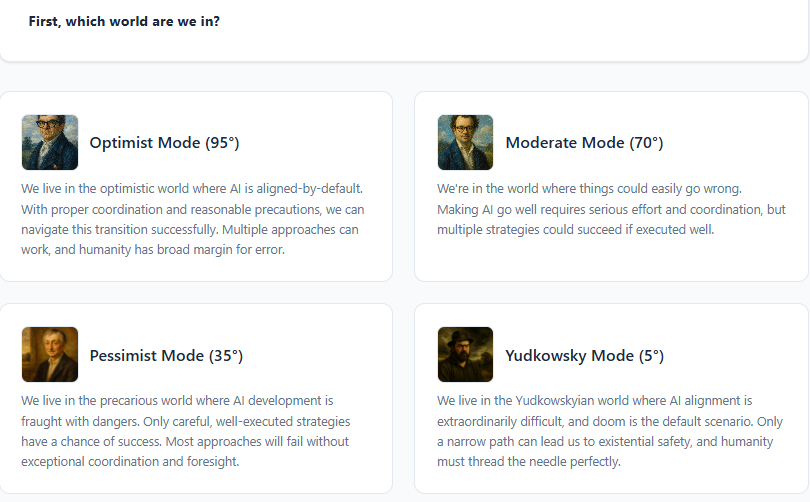
Choose your underlying worldview/difficulty (with beautiful pictures of famous AI figures)
Choose how many resources you have as a global leader in charge of AI governance
Choose a strategic posture, a bundle of institutions, some legal mechanisms, and a few technical controls
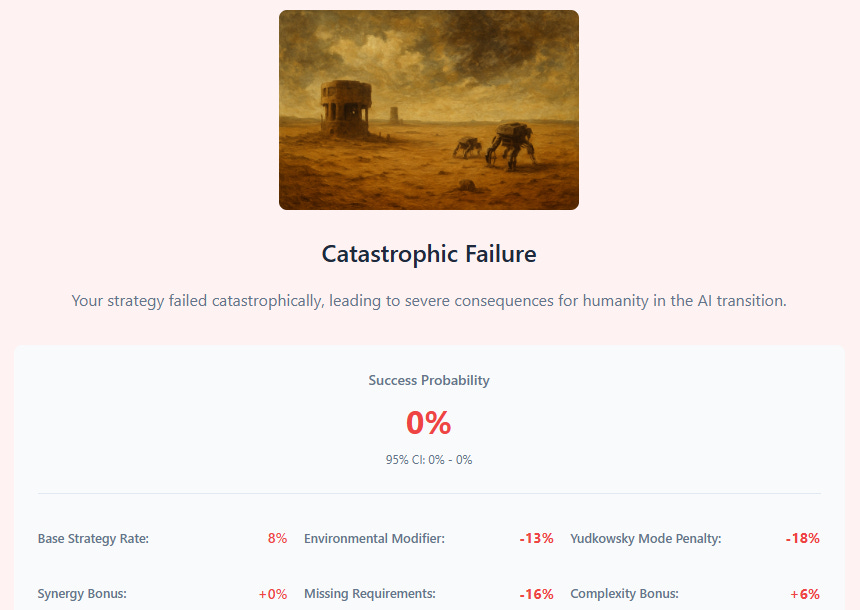
The engine adds your underlying worldview, random chance, synergies and penalties between institutions etc., then runs a Monte Carlo simulation.
You then get an outcome for humanity. In the “Yudkowsky World” (doomer mode), my demo policy set scored 0% chance of success, and grimly ended in catastrophic failure. Can you do any better?
How to play
If you feel like playing, I’d recommend running through the options a few times and thinking about how different mechanisms might work or go together. You can click on the links for more of a description on how something works, and you can check out the database for more links.
Try it out based on your own beliefs! If you believe that “if anyone builds it, everyone dies”, you'll probably support a Global Moratorium. You can then choose Yudkowsky mode, pick and choose the concrete institutions and mechanisms that might save the day (e.g. strong global institutions, strict regulations on model size and hardware-based restrictions).
If you think that things will probably just work out, you can put it on LeCun mode and go laissez-faire and see how things turn out.
The game was fun to make, and I hope you’ll be able to learn a bit about AI governance. It doesn’t really capture any of the real-world challenges that make AI governance so difficult, but the wonders of GitHub mean that you’re free to steal the idea and make something better.
This is the Github page: https://github.com/Jack-Stennett/AI-Governance-Strategy-Builder
And the game link again: https://jack-stennett.github.io/AI-Governance-Strategy-Builder/
This is very interesting! I'm curious about how you're modelling political capital. Is there a system you're using to decide how much PC options cost, or is it just based on vibes?
If you (or someone...) makes a v2, it could be interesting to also have resources for "US buy-in", "Chinese buy-in", and "EU buy-in": some requirements are more onerous for some players, and various incentive schemes could bring one player onside at the cost of another. (EU is currently not a major AI player, but they theoretically could be, and could contribute to mechanisms even if they're not hosting cutting-edge labs)
Excellent! My systemizing brain loved it. Sharing this with friends